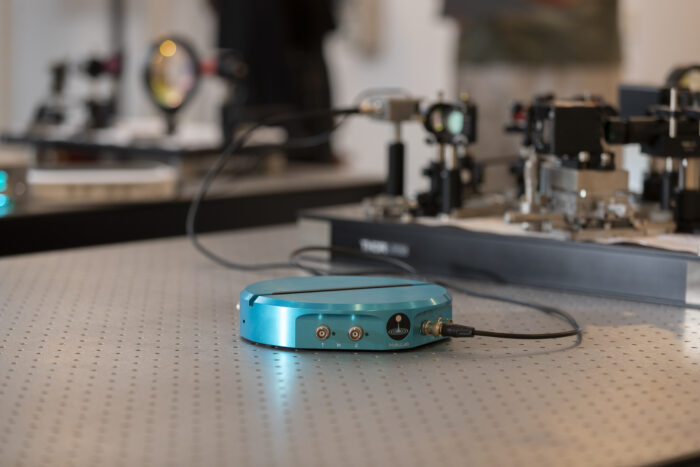
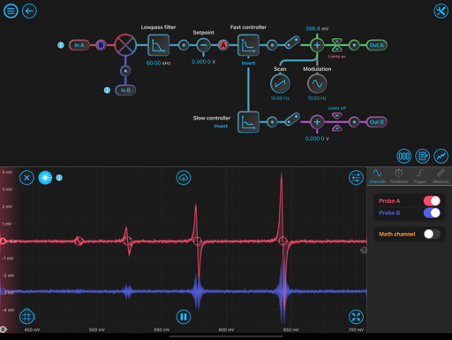
The Moku Lock-in Amplifier supports dual-phase demodulation (X/Y or R/θ) from DC to 600 MHz. It also features an integrated two- or four-channel Oscilloscope and Data Logger, enabling you to observe signals at up to 1.25 GSa/s and log data at up to 10 MSa/s.
The Moku Lock-in Amplifier is easy to use and offers a range of advanced capabilities to optimize your experiment — at the most cost-effective price in the industry. Watch the video to learn more.[/lq_centered_text]
[lq_centered_text]
Key benefits of the
Moku Lock-in Amplifier
From a built-in Data Logger and Oscilloscope to the ability to deploy multiple lock-ins for deeper insights, you can expect more from the Moku Lock-in Amplifier.[/lq_centered_text]
[lq_image_text_top_bottom image=”13769″]
Dual-phase demodulation for enhanced measurement accuracy
The Moku Lock-in Amplifier features a dual-phase demodulator with cascaded, single-pole lowpass filters to attenuate the second harmonic and suppress noise in each quadrature.
Select between 6, 12, 18, and 24 dB / octave lowpass filter slopes
Select between rectangular (X/Y) and polar (R/θ) coordinate modes
View the demodulated in-phase and quadrature signals prior to the lowpass filters using the integrated Oscilloscope
[/lq_image_text_top_bottom]
[lq_image_text_top_bottom image=”7959″]
Unlock greater insights with additional embedded instruments
Monitor up to four signals at a time using the Moku Lock-in Amplifier’s integrated 4-channel, 1.25 GSa/s Oscilloscope, and continuously log data at up to 10 MSa/s using its built-in Data Logger. Additionally, the integrated PID Controller provides real-time control over gain profiles with configurable saturation.[/lq_image_text_top_bottom]
[lq_image_text_top_bottom image=”7960″]
The Moku Lock-in Amplifier offers internal and external references for maximum flexibility
Configure the local oscillator source to suit different applications. Select from internal or external demodulation references, or bypass the mixer stage altogether. Use the internal PLL frequency multiplier to demodulate up to the 250th harmonic or down to 0.125x of the fundamental frequency.[/lq_image_text_top_bottom]
Measure more, instantly, from your preferred operating system
Wirelessly configure and monitor your setup’s performance from intuitive Moku software for iPad, Windows, or Mac applications. Moku software provides a clear and dynamic user experience so you can quickly configure, modify, and debug your setup.[/lq_Video_image_text_top_bottom]
[lq_image_text_top_bottom image=”11278″]
Engineered to work seamlessly with your favorite APIs
API integration with MATLAB, LabVIEW, and more allows straightforward automation of your Moku device in complex setups or for repetitive tasks. Save your measurements, screenshots, traces, and other settings locally or to your preferred cloud app. You can also send work to yourself or colleagues within the Moku app.[/lq_image_text_top_bottom]
[lq_centered_text]
Engineered for demanding applications
You can’t innovate for the future when your test equipment is stuck in the past. Use the Moku Lock-in Amplifier to accelerate development timelines with speed and flexibility unmatched by any other instrument in its class.[/lq_centered_text]
Analog
radio
Laser frequency
stabilization
Laser scanning
microscopy
Magnetic
sensing
Pump probe /
ultrafast spectroscopy
Integrates seamlessly with your tech stack
[lq_centered_text]
Specifications and
technical documents
The Moku Lock-in Amplifier runs on Moku:Pro, Moku:Lab, and Moku:Go. Compare the specifications to choose the right device for your application[/lq_centered_text]
[lq_centered_text]1 mHz to 600 MHz[/lq_centered_text]
[lq_centered_text]1 mHz to 200 MHz[/lq_centered_text]
[lq_centered_text]1 mHz to 30 MHz[/lq_centered_text]
Dual-phase demodulation
[lq_centered_text]X/Y or R/θ[/lq_centered_text]
[lq_centered_text]X/Y or R/θ[/lq_centered_text]
[lq_centered_text]X/Y or R/θ[/lq_centered_text]
Demodulation modes
[lq_centered_text]Internal, external (direct local oscillator input or phase-locked loop with frequency multiplier from 0.125x to 250x), with the option to bypass the mixer stage[/lq_centered_text]
[lq_centered_text]Internal, external (direct local oscillator input or phase-locked loop with frequency multiplier from 0.125x to 250x), with the option to bypass the mixer stage[/lq_centered_text]
[lq_centered_text]Internal, external (direct local oscillator input or phase-locked loop with frequency multiplier from 0.125x to 250x), with the option to bypass the mixer stage[/lq_centered_text]
Dynamic reserve
[lq_centered_text]> 120 dB[/lq_centered_text]
[lq_centered_text]> 120 dB[/lq_centered_text]
[lq_centered_text]> 100 dB[/lq_centered_text]
Filter time constant
[lq_centered_text]From 12.8 ns to 0.215 s[/lq_centered_text]
[lq_centered_text]From 32 ns to 0.537 s[/lq_centered_text]
[lq_centered_text]From 128 ns to 2.15 s[/lq_centered_text]
Input impedance
[lq_centered_text]50 Ω / 1 MΩ[/lq_centered_text]
[lq_centered_text]50 Ω / 1 MΩ[/lq_centered_text]
[lq_centered_text]1 MΩ[/lq_centered_text]
Output gain range
[lq_centered_text]-80 to +160 dB[/lq_centered_text]
[lq_centered_text]-80 to +160 dB[/lq_centered_text]
[lq_centered_text]-80 to +160 dB[/lq_centered_text]
Local oscillator output
[lq_centered_text]Up to 600 MHz with variable amplitude[/lq_centered_text]
[lq_centered_text]Up to 200 MHz with variable amplitude[/lq_centered_text]
[lq_centered_text]Up to 20 MHz with variable amplitude[/lq_centered_text]
[lq_centered_text]Demodulation frequency
1 mHz to 600 MHz[/lq_centered_text]
[lq_centered_text]Dual-phase demodulation
X/Y or R/θ[/lq_centered_text]
[lq_centered_text]Demodulation modes
Internal, external (direct local oscillator input or phase-
locked loop with frequency multiplier from 0.125x to
250x), with the option to bypass the mixer stage[/lq_centered_text]
[lq_centered_text]Demodulation frequency
1 mHz to 200 MHz[/lq_centered_text]
[lq_centered_text]Dual-phase demodulation
X/Y or R/θ[/lq_centered_text]
[lq_centered_text]Demodulation modes
Internal, external (direct local oscillator input or phase-
locked loop with frequency multiplier from 0.125x to
250x), with the option to bypass the mixer stage[/lq_centered_text]
[lq_centered_text]Demodulation frequency
1 mHz to 20 MHz[/lq_centered_text]
[lq_centered_text]Dual-phase demodulation
X/Y or R/θ[/lq_centered_text]
[lq_centered_text]Demodulation modes
Internal, external (direct local oscillator input or phase-
locked loop with frequency multiplier from 0.125x to
250x), with the option to bypass the mixer stage[/lq_centered_text]
From detailed case studies featuring real-world users to comprehensive application notes that explore instrument features and functions, we offer a range of resources to help you work smarter and achieve more with the Moku Lock-in Amplifier.[/lq_centered_text]
Exploring laser frequency stabilization and laser locking techniques
Learn how to implement laser locking and laser stabilization for applications in quantum optics, gravitational wave detection, and more
Accelerating multiparameter estimation in quantum optics experiments with Moku:Lab
How quantum metrology researchers are approaching the limit of precision with software-defined instrumentation
What’s a digital lock-in amplifier, and how does it work?
Comparing analog and digital lock-in amplifiers to determine which is best for your application
MEMs characterization 101: Everything you need to know
These small devices are already a big part of technology. But how do we perform MEMS characterization?
Optimizing an SRS Lock-in Amplifier for stimulated Raman scattering research
Discover the essential characteristics of a lock-in amplifier and how to integrate one into your SRS microscopy experiment
Advancing optical clock performance with Moku:Pro
Learn how researchers at Humboldt University of Berlin and the Ferdinand-Braun-Institut are using a digital-first approach to eliminate tedious manual processes, automate essential tests, and optimize clock stability