Your cart is currently empty!
Category: Lock-in Amplifier
-

Exploring laser frequency stabilization and laser locking techniques
The laser is one of the most important inventions of the 20th century, as far as experimental physics is concerned. Since the first demonstration of a laser in 1960, they have become ubiquitous in research labs across the world, forming a cornerstone of modern optics and quantum research. Laser stabilization, also known as laser locking,…
-

Accelerating multiparameter estimation in quantum optics experiments with Moku:Lab
Almost everyone who has a passing interest in physics has heard of the Heisenberg uncertainty principle. In its most famous postulation, it relates the fundamental uncertainty in the knowledge of both a particle’s momentum and position, simultaneously. The product of the uncertainties has a lower bound; improving precision in measurement of one value generally reduces…
-

What’s a digital lock-in amplifier, and how does it work?
Digital lock-in amplifiers help scientists and engineers make phase-sensitive measurements of incredibly small alternating current (AC) signals, sometimes buried beneath the noise floor (Figure 1). By providing a lock-in amplifier with a reference signal, a researcher can extract phase and amplitude information from a signal of interest in the same frequency region, even in an…
-
MEMs characterization 101: Everything you need to know
Everywhere you look, it’s obvious: Devices today are getting smaller. What you may not realize is how small they’re truly becoming. Enter microelectromechanical systems (MEMS). MEMS are tiny devices or systems with both electrical and mechanical components. These systems range from a few micrometers to a few millimeters in size. At these scales, there is…
-
Optimizing an SRS Lock-in Amplifier for stimulated Raman scattering research
Stimulated Raman scattering (SRS) microscopy is a widely used technique for label-free chemical imaging that leverages the coherent Raman scattering process. While the spontaneous Raman effect is a weak scattering process that can take hours of signal integration time for a single field of view, coherent scattering methods like SRS provide a non-destructive, label-free technique.1…
-

Advancing optical clock performance with Moku:Pro
Introduction Humboldt University of Berlin is a prestigious public institution in Germany with a long history of supporting leading-edge scientific research. The university is linked to countless major breakthroughs in physics, and its impressive roster of faculty alumni includes none other than Albert Einstein. Julien Kluge, a Ph.D. candidate in the Joint Lab Integrated Quantum…
-

Shining light through a wall: Axion detection at DESY with Moku:Lab and Moku:Pro
Introduction The Any Light Particle Search (ALPS) is a research group at Deutsches Elektronen-Synchrotron (DESY), a world-renowned research institution for fundamental science based in Hamburg — and Germany’s largest accelerator center (Figure 1). Following the institution’s motto, “the decoding of matter,” postdoctoral researcher Todd Kozlowski is working on an axion detection project to better understand…
-

Laser locking with closed-loop transfer function measurement
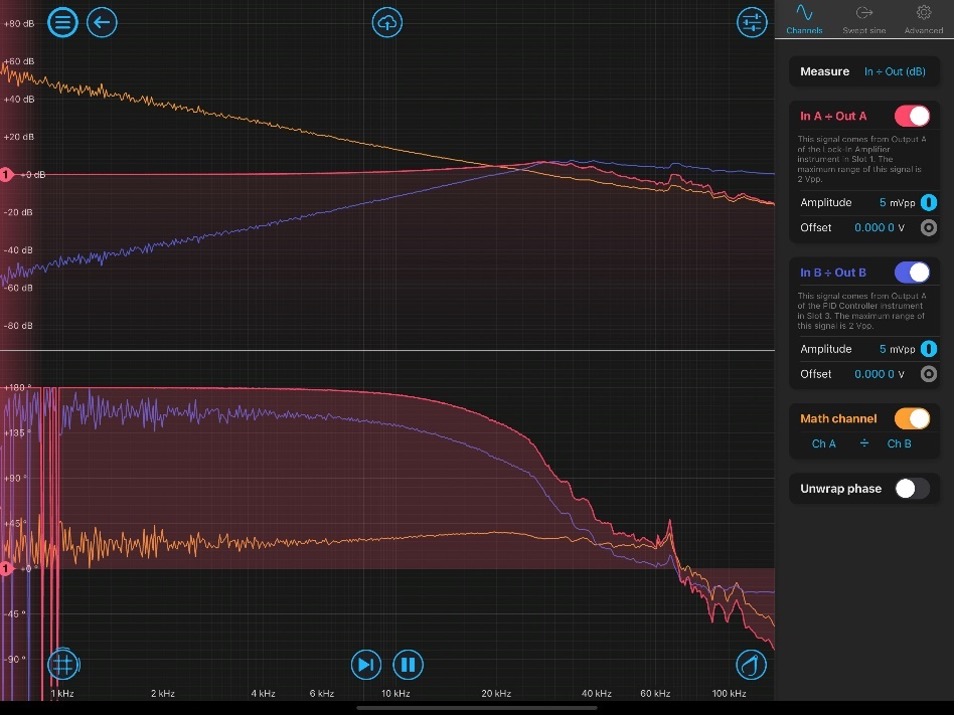
Multi-instrument Mode on Moku:Pro allows you to lock lasers to optical cavities with the Laser Lock Box while also measuring the Bode plots by using the Frequency Response Analyzer (FRA) with no additional test equipment or wiring. By injecting a disturbance into the error signal and measuring the transfer function using the FRA, you can check…
-

Using Moku:Pro for photonic IC control system research at Intel Labs
Introduction Researchers at Intel Labs’ photonic device research lab are working on a range of cutting-edge projects to advance and maximize the advantages of heterogeneously integrated silicon photonic integrated circuits (PICs). As team members typically explore new designs at a rapid pace in a highly experimental setting, they need reconfigurable, scalable tools with a small…