Your cart is currently empty!
Author: jpatterson
-

What’s a digital lock-in amplifier, and how does it work?
Digital lock-in amplifiers help scientists and engineers make phase-sensitive measurements of incredibly small alternating current (AC) signals, sometimes buried beneath the noise floor (Figure 1). By providing a lock-in amplifier with a reference signal, a researcher can extract phase and amplitude information from a signal of interest in the same frequency region, even in an…
-
MEMs characterization 101: Everything you need to know
Everywhere you look, it’s obvious: Devices today are getting smaller. What you may not realize is how small they’re truly becoming. Enter microelectromechanical systems (MEMS). MEMS are tiny devices or systems with both electrical and mechanical components. These systems range from a few micrometers to a few millimeters in size. At these scales, there is…
-
Optimizing an SRS Lock-in Amplifier for stimulated Raman scattering research
Stimulated Raman scattering (SRS) microscopy is a widely used technique for label-free chemical imaging that leverages the coherent Raman scattering process. While the spontaneous Raman effect is a weak scattering process that can take hours of signal integration time for a single field of view, coherent scattering methods like SRS provide a non-destructive, label-free technique.1…
-

Impedance measurements with Moku:Go – Part 2: Inductance
This application note presents an example and discussion of how to make accurate impedance measurements with a Moku:Go device. In Part 1, we explored the math of measuring resistance using voltage measurements from the software-defined Moku Frequency Response Analyzer. Now in Part 2, we’ll explore inductance measurements. Using the Moku Frequency Response Analyzer The Moku…
-

Advancing optical clock performance with Moku:Pro
Introduction Humboldt University of Berlin is a prestigious public institution in Germany with a long history of supporting leading-edge scientific research. The university is linked to countless major breakthroughs in physics, and its impressive roster of faculty alumni includes none other than Albert Einstein. Julien Kluge, a Ph.D. candidate in the Joint Lab Integrated Quantum…
-

Shining light through a wall: Axion detection at DESY with Moku:Lab and Moku:Pro
Introduction The Any Light Particle Search (ALPS) is a research group at Deutsches Elektronen-Synchrotron (DESY), a world-renowned research institution for fundamental science based in Hamburg — and Germany’s largest accelerator center (Figure 1). Following the institution’s motto, “the decoding of matter,” postdoctoral researcher Todd Kozlowski is working on an axion detection project to better understand…
-

How to optimize PDH laser locking with the Moku:Pro Laser Lock Box
The Moku:Pro Laser Lock Box integrates multiple crucial electronic components of the Pound-Drever-Hall laser locking technique into one instrument, making the laser locking process easier than ever without compromising performance. This app note will cover the principles of PDH locking, outline the procedure for locking a laser to a high-finesse cavity using the Moku:Pro Laser…
-

Impedance measurements with Moku:Go – Part 1: Resistance
This application note presents an example of making impedance measurements using the Moku:Go device. Here in Part 1, we will explore the underlying mathematical principles of measuring resistance and its accuracy using the software-defined Moku Frequency Response Analyzer. In Part 2, we expand our analysis to include inductance. In Part 3, we will explore capacitance.…
-

Building a sustainable, competitive solar car with Moku:Go and the Chalmers Solar Team
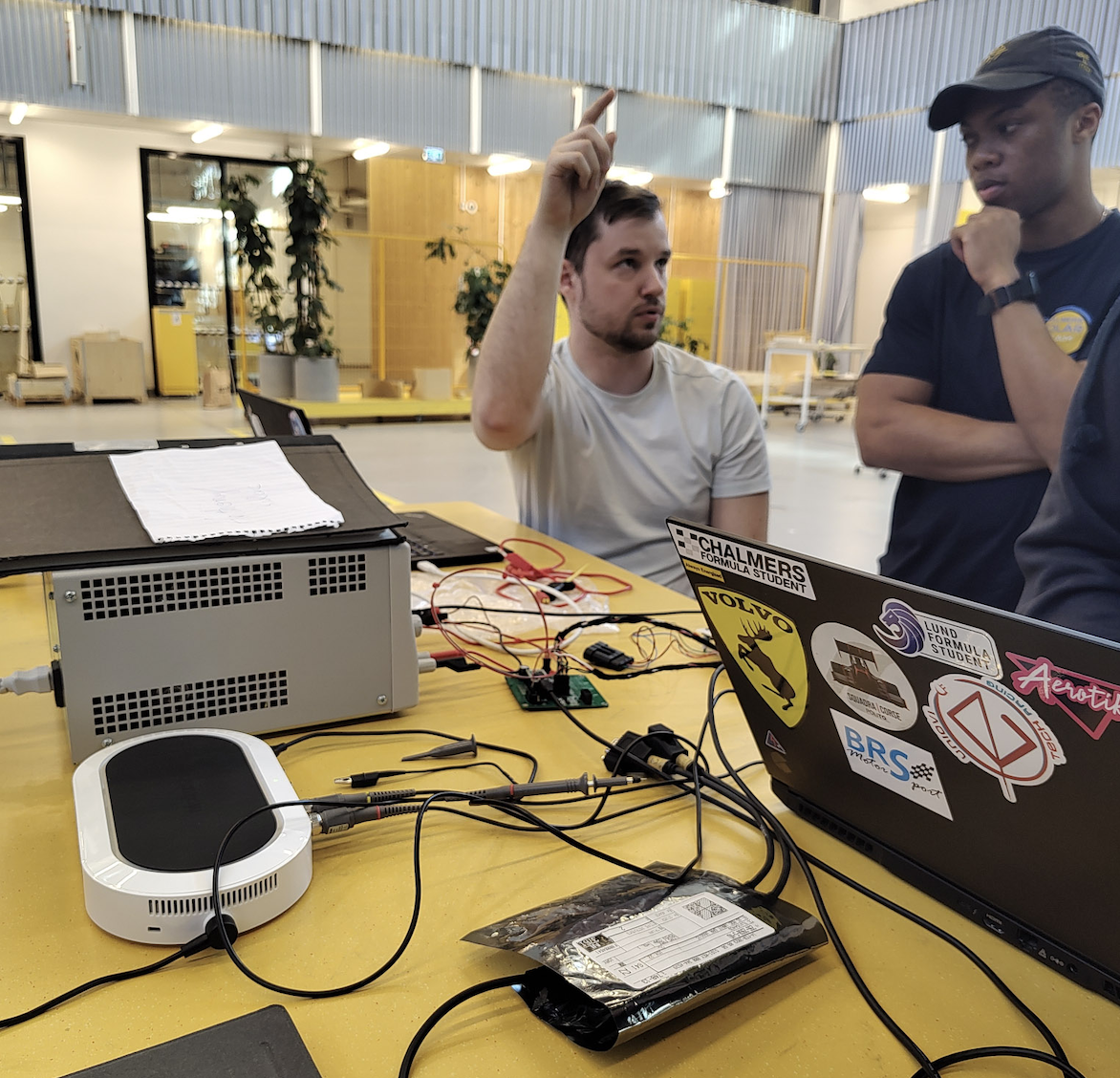
Introduction Founded in 2018 in Gothenburg, Sweden, the Chalmers Solar Team is a student-driven, nonprofit project aiming to build competitive, sustainable solar-powered electric cars (Figure 1). The team competes in the Bridgestone World Solar Challenge, an annual event that attracts teams from leading universities around the globe to put their designs to the test in…